
TCG Card Shop Simulator Card Grading: Costs, Timing and Odds
The four grading services in TCG Card Shop Simulator with their prices and turnaround, plus the probability pools that decide whether a card comes back a 10.

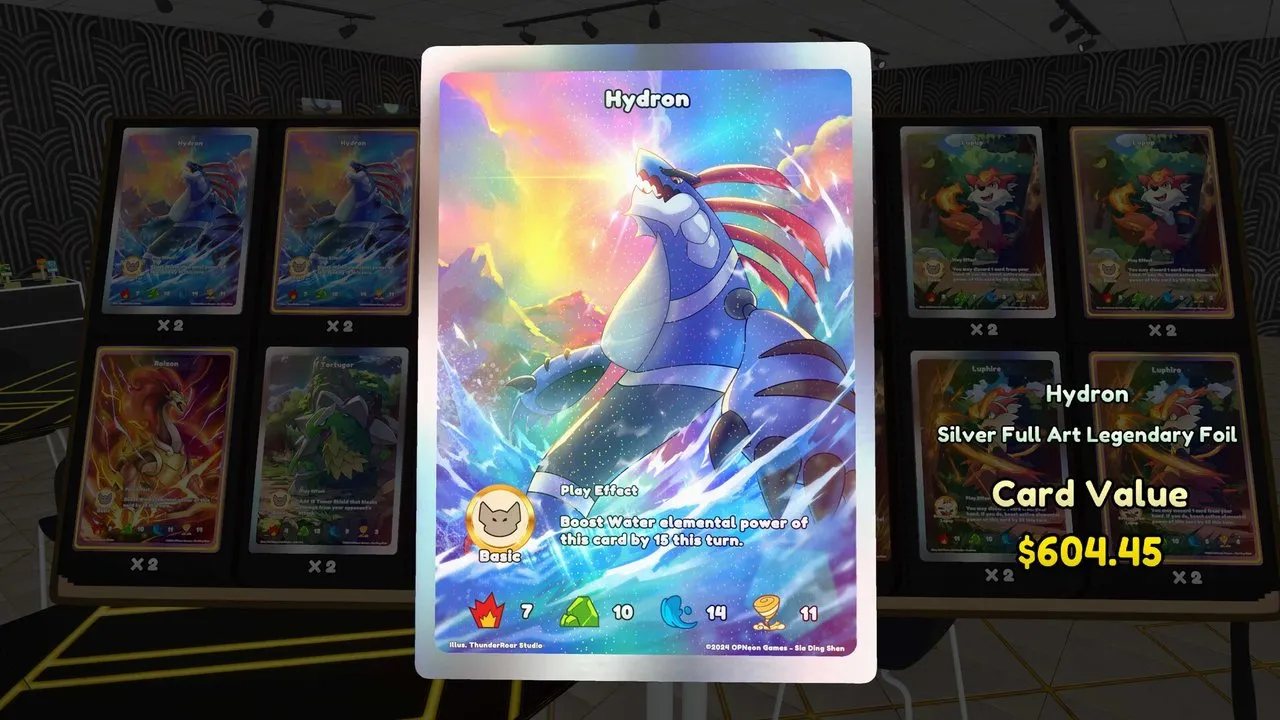
Grading is a time trade: you pay a fee per card, wait, and hope the card comes back valuable enough to cover both. The Cardinal’s Grading app takes up to eight cards per submission and allows four active orders at once.
That ceiling of 32 cards in flight is the real constraint.
The four services
| Service | Processing time | Price per card |
|---|---|---|
| Value | 12 days | $10 |
| Standard | 7 days | $40 |
| Express | 4 days | $200 |
| Premium | 2 days | $1,500 |
Every submission adds a fixed $10 shipping fee on top. Orders placed after 1pm start processing the next day.
Premium looks absurd until you do the arithmetic on volume. At $1,500 per card it only makes sense if you are grading dozens of cards worth tens of thousands each.
How the grade is decided
The system runs in two stages. First the game picks a probability pool, then it resolves a final grade inside that pool.
The pool split is lopsided:
- 96% of cards enter the high-quality pool, which resolves to grades 5 through 10
- 4% enter the low-quality pool, which resolves to grades 1 through 5
Inside the high-quality pool the checks run in sequence: a 40% chance of a 10, then 40% for a 9, then three 50% steps for 8,7 and 6, with 5 as the remainder.
The final odds per grade
| Grade | Chance |
|---|---|
| 10 | 38.40% |
| 9 | 23.04% |
| 8 | 17.28% |
| 7 | 8.64% |
| 6 | 4.32% |
| 5 | 5.92% |
| 4 | 1.20% |
| 3 | 0.60% |
| 2 | 0.30% |
| 1 | 0.30% |
Those figures come from the community wiki, which derived them by combining the sequential checks. Small rounding differences are possible.
The practical consequence is that a 10 is common and a 1 is almost impossible. If you want a full 1-to-10 set for the related achievement, re-grading is the only realistic route.
Re-grading moves a card one step
Re-grading has three outcomes and they are close to even: a 30% chance of moving up one grade, a 40% chance of no change, and a 30% chance of moving down one.
That is a coin flip with a slight upward tilt, and it caps at 10 and bottoms at 1.
What is worth sending in
One widely cited rule of thumb puts the threshold at $100. Cards below that rarely cover the service fee plus shipping, and cards above it are usually worth the wait.
Above that threshold, fill each submission with eight cards. The $10 shipping charge is per order, so four near-empty orders cost you more than one full one.
The other advice is about pacing. A frequent recommendation is to stay on the 4-day Express service so cards come back steadily, and only move to the 2-day Premium tier once your retail side is earning around $5,000 of profit a day.
The time problem, and the furniture that solves it
Grading is slow in both in-game and real time. Even the fastest service takes two in-game days, which is roughly half an hour of play.
The pack-opening machines help. They run in real time and can hold a large load, so you can feed them while you do everything else. One experienced writer recommends buying them before installing a fast-open mod, because they free your hands rather than just compressing an animation.
What is not documented
Graded card values vary per save file. The wiki states that prices are generated when a save is created, which means the same card can be worth very different amounts in two different games.
The developer has never published the grading table. Every number on this page comes from community documentation or player testing, and patch 1.0 adjusted Tetramon card values without saying which ones.
Related Articles
cards
TCG Card Shop Simulator Card Sets and Packs Explained
Every pack line in TCG Card Shop Simulator, what the Destiny variants change, where ghost cards come from, and how 1.0 pushed the card pool to 4,436.
guide
TCG Card Shop Simulator Money Guide: What Actually Sells
Which products carry the best margin in TCG Card Shop Simulator, how high you can price them, and what to do with cheap cards that never sell.